Rainfall
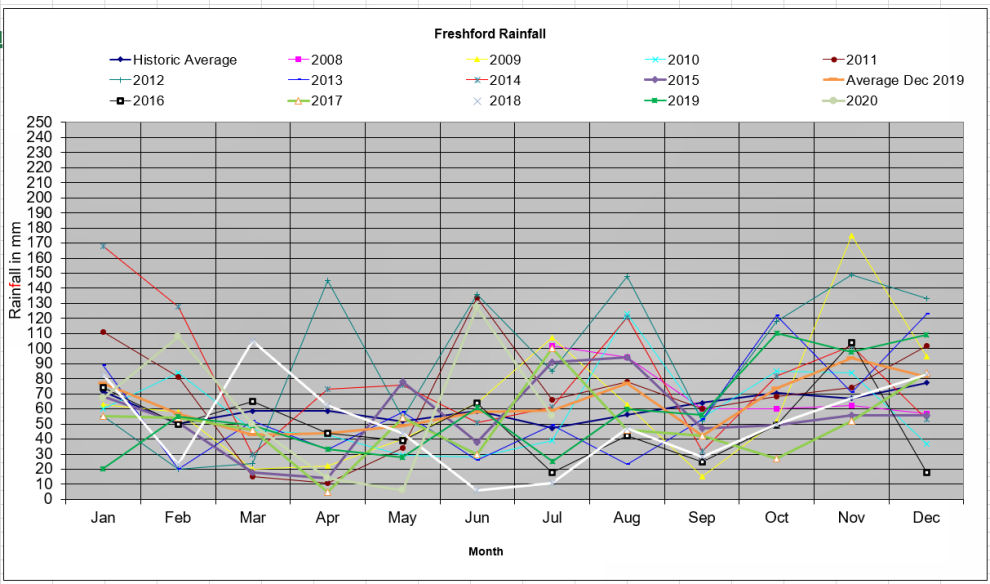
Freshford Somerset Although my measurements
are not official I am closer to the location than the Met
office's nearest station. Are we having more rainfall than
in the past? No see:
Historic Rainfall Record Nearest Station Lyneham
(1971-2000). The total average rainfall varies with no
trend. The stats are for a period of over ten
years so any trend is unreliable but is improving.
Freshford has a mild climate. Even the high rainfall
figures shown below are monthly figures whereas we hear
quite frequently of that amount of rainfall falling over
one day in many parts of the UK. If we did have a very
heavy fall of rain together with a high tide at
Avonmouth and if the ground were to be waterlogged,
Freshford Mill would be again flooded and to a much
higher level than in 2008. The 2008 flood was after a
long period of rain, not a heavy deluge. The site has
been flooded again in November 2012 see
Freshford Somerset
for photographs
and December 2013 (no photos were taken on site owing
to difficulty of access). There has been little
opportunity to see the effect of the recent flood
defences in place at Freshford Mill.
The
chart below is updated at the end of each month. NB that driving rain cannot be recorded. It should be noted that the rainfall is actually
more than what is recorded unless there is no driving rain.
Update please note that after a night of hig hwind and
driving rain no rainfall was measured! Bearing in
mind that the graphs have become almost too crowded to
read I have decided to stop recording rainfall, I do not
have the equipment to record drviing rain.
July rain 2020 total
55mm. Average
rainfall 47.2mm. NB. Next chart update end of
August 2020
74mm to
date
28/08/2020.
Historic average 56.1mm Rain is measured
each morning but might be added later in the day. 1mm recordings
or less are often carried forward. It follows that
the first day of the month loses its rainfall, if any,
from midnight till when the reading is taken in the
daytime as that rainfall if any, is added to the previous
month's record. In practice if there is a lot of rain
during the evening of the last day of the month I take a reading -but possibly not at midnight.
Data file link updated at the end of the month: Data file
Freshford Mill Flooded March 2008
During Saturday
and Sunday the rainfall locally was in excess of 55mm, my
rainwater gauge couldn't take the amount that fell. Subsequently
I awoke to find that the river Frome valley was flooded
and Freshford was isolated for the rest of the weekend.
Whilst the regular floods tend to dissipate fairly quickly
there is no denying the power of the river as the following
photos show.
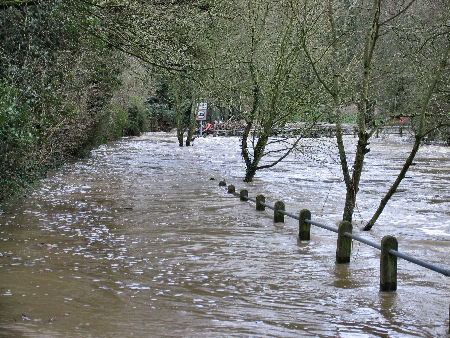
River Frome flooding has reached
the top of the railings in the approach to Mill bridge.
The bridge railings have trapped debris that floats downstream
Flooded field by Freshford
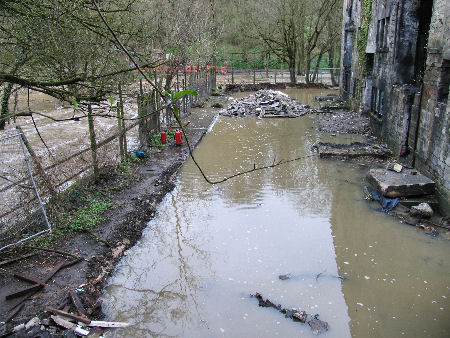
Mill. Mill race area flooded
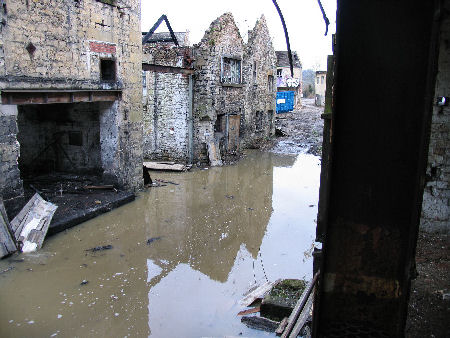
Photos showing two views
of "street" of buildings at Freshford Mill flooded
on the weekend of the 15th and 16th March 2008
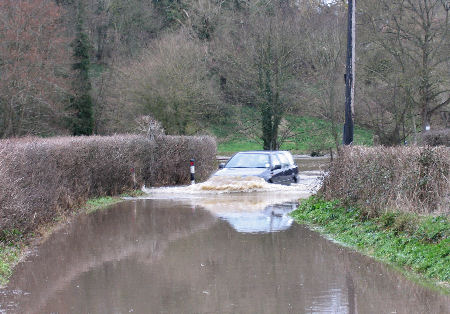
A brave or foolhardy driver negotiating
lower Staples Hill by the bridge
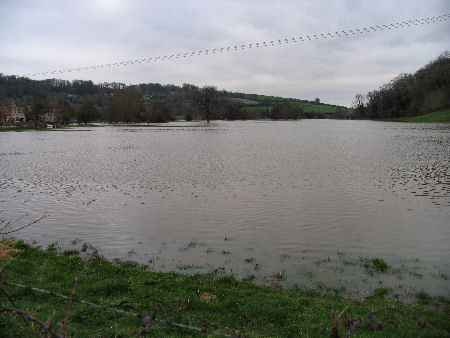
A view across the flood plain
by Freshford bridge
Freshford
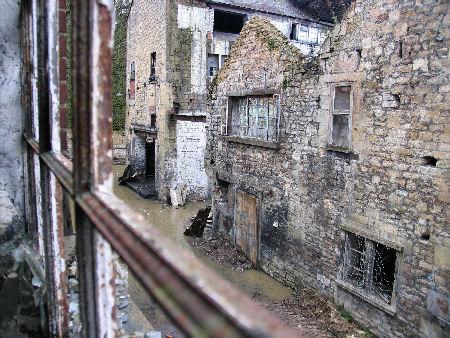
Mill: more Photos
of the Flooded areas and Remaining Buildings
National Floods England June and July 2007
Freshford Mill Escapes Flooding
However, with people dying of floods
(June 25th 2007) deep concern needs to be expressed for the approval
of a development that will need extraordinary measures to protect its
inhabitants against flood. These measures include importing rubble to
build up the land, even though this is undesirable, as it reduces the
land's ability to absorb flood water.
BBC News 27th June
2007 The consequences of such flood mitigation measures at
Freshford Mill will reflect on the environmental impact of the development
and are likely to be most unattractive..
This area of the country escaped the rainfall that
other areas have had over this period. In fact the total rainfall at
Freshford Mill for June was 102mm which was less rain than we had in
May which was 129mm. The current rainfall total for July is a mere 102mm.
Fortunately, the
tide at Avonmouth was low during the period of our highest rainfall
in this area. At the end of the month with the tide becoming much higher
with the full moon the risk increases, but fortunately the weather forecast
is for better weather. August total rainfall 66mm
The website has been
optimised for Internet Explorer at its most common display resolution
of 1024 x 768. Furthermore there are photographs and video files
that are best suited to a broadband connection. I make no apology for
designing the website to these parameters as the intention is to assert
the argument that we live in an extraordinary area of the country and
this message is best portrayed by publishing high quality photographs.
Most of the photographs are mine. I do not claim that I have by means
of my photographs conveyed the magnificence of this countryside, in
fact I believe that I have only tried to do so. Perhaps Joe Cornish,
a renowned landscape photographer, might be encouraged to visit this
area of England and spend some time photographing what we, as residents
regard to be countryside of outstanding value, but are unable to fully
capture on film.
The Department for the
Environment, Food and Rural Affairs
The Department for the
Environment, Food and Rural Affairs
DEFRA requested that the planning
application for redeveloping the site known as Freshford Mill
should be 'called-in' for their approval,
before a decision is made. Unfortunately, DEFRA has now decided
NOT to 'call-in' the planning application, and the BANES Development
Control Committee has decided
to 'permit'.
The Government Office of the South West and "Planning
Matters"
In fact the decision Not
to call in the planning application was NOT made by DEFRA but by the
Government Office for the South West. An individual known as A. Citizen
wrote about this matter on the website
www.lettertothepm.co.uk
and there is a correspondence on the article entitled "Planning Matters"
published there.
A letter written to Freshford residents in June 2000 has
information about the Inspector's Report that advises against residential
use. Freshford
Mill (Peradins) Inspector's Report
As this particular application
has such important national ramifications for the erosion of the Green
Belt which in this case is also within an Area Of Outstanding Natural
Beauty and an Area of High Ecological Value we are entitled to know
why DEFRA has changed its mind, especially when Freshford Parish Council
had provided a long list of very closely reasoned objections to this
planning application. (that
can be read here) The correspondence on
www.lettertothepm.com provides
the "official reasons" unsatisfactory, although that may be.
Geoff Edwards (resident)
NB In spite
of having several months to correct an error, by the Ordnance Survey
(that the Environment Agency relies on) Freshford Mill is still depicted
as being outside of the flood plain. This error in any third World country
would be regarded as corruption at the highest level. Make no
mistake Freshford Mill and the proposal by Southern & Counties for more
than 20 dwellings -that has been approved by BANES planning officers
in spite of total opposition from the residents of Freshford and their
Parish Council -lies entirely under water in the event of a flood. The
residents could only be rescued by boat or helicopter. A thirteen ton
fire engine was washed off the road a few hundred yards from Freshford
Mill in 2000. Correct DEFRA map here
Incorrect DEFRA online maps here
Apparently concerns over corruption have been allayed by my research
that I am sure both DEFRA and the Ordnance Survey could have resolved
if they had the mind to. The full details are discussed on:
Freshford Mill OS Maps
Since I was a child I have
become aware by regular visits to the countryside with my parents that
some parts of our countryside: the most beautiful, romantic, and
interesting have been preserved for the nation by the National Trust.
Land purchased by the National Trust (NT) is going to be safe for ever.
Members of the NT provide the
funds that are needed, and there are volunteers who help to maintain
areas. When we see real countryside, we are often looking at a NT property
or one owned by the Crown, a wealthy or aristocratic landlord or one
owned by a large company.
Some of our countryside and
cityscapes are protected by the establishment of National Parks, Areas
of Outstanding Natural Beauty and the Green Belt. In these areas local
planning has more control over what residents, business and organisations
can do. And there are Conservation Areas that further curtail and control
indiscriminate development.
Philosophy and Nature is a page
of this web site where I have tried to convey my views of our responsibilities,
I suppose we could take for granted, or agree, that preserving our physical
heritage: structures, landscapes and seascapes is obviously important
if not vitally important, but maybe the proposition needs to be
set down on paper to reflect upon.
Freshford Mill
Freshford Mill is located
on the River Frome in Somerset ten minutes walk from the
Inn at Freshford and close to
the border with Wiltshire.
Freshford is a particularly
attractive village within the Cotswolds Area of Outstanding Natural
Beauty (AONB) the village is about six miles South of the World Heritage
City of Bath. The nearest town is Bradford On Avon which is about 3
miles away Geographically, the area consists of hills and
three rivers: the Avon, Frome and Midford Brook. The latter is not exactly
a brook! it has been known to flood the Old Bath road and a substantial
viaduct had to be built over the Midford Brook valley to accommodate
the A36. these rivers undoubtedly add considerably to the great charm
of the countryside. They have sculpted out the deep valleys over hundreds
of thousands of years. As for the roads, apart from the single carriageway
A36 all the roads are narrow, steep, and single track. with little,
or no provision for passing except by using private driveways. View
a recent appraisal of Freshford and Sharpstone Conservation Area by
BANES Planning here
Where the River Frome meets
the river Avon there is an extensive meadow - a flood plain. The flood
plain is an essential feature that helps to contain the regular floods
and one must suppose, as there will be more floods in the immediate
future, as global warming continues to affect our weather, that the
existence of these meadows will be even more important. "Flood
plains are called flood plains for a reason - they flood"
Bob Spicer Professor of Earth Sciences the Open University and
2007 Lead Academic Consultant on BBC1 "Climate Change - Britain Under
Threat", I hour Attenborough programme; contributor to accompanying
websites; press interviews
In fact, the existence of
the Freshford Mill site, is itself, a threat to increased flooding elsewhere
as the whole site has already been raised above the surrounding land.
It would be good sense to remove not only the factory buildings but
also the man-made plateau on which the buildings exist. There are also
problems in Freshford when there is a cold spell due to snow and ice.
The
Freshford Mill Works (Peradins)
is currently subject to a planning application for 21 dwellings . .
. The residents of Freshford and their parish council, and we thought
the area council had rejected
the application by Southern & Counties (Suttons) Ltd. However, the
application has now been approved by the
Bath & North East Somerset Planning Service under a recommendation
from Area "B" Development Committee.
With no information given for its approval other than an underlying
agreement that something does need to be done to remove the eyesore!
The complete documentation for the application is available at
Planning Services using the 'Public Access' service. To search you
will need to enter the Application Ref 05/02563/FUL Note: if you
include a space the search will fail, you should then be directed to
a results page.
There has been talk that the
application was approved because there is no other plan for the development
of the site. However, that is not the case as a plan for the redevelopment
of the site has been approved by the council: The
creation of a rural recreation area, nature sanctuary and workshops
in 2005.I understand that thisparticular plancould not be implemented without the necessary funds to buy the
site. Since this eyesore is within an Area of Outstanding Natural Beauty
(AONB) we would have thought that money should be available, since the
purpose of this type of legislative instrument is meant to protect parts
of the countryside for the benefit of all. As an Area of High
Ecological Value with especially rare bats that may not survive the
noise and turmoil of the development there is even more reason not to
allow this development to go ahead. Penalties for even disturbing
bats is severe see:
Bat Crime Investigations
This is what the situation
looks like: entice developers to barter money for environmental cleanup
in exchange for planning approval for dwellings? Is this the only way
we can have the mistakes of former planning decisions cleaned up? The
reality is that the developers, will most likely, recoup their money
and more from wealthy people who will buy these dwellings -they won't
be welcome here. They will be isolated from the village geographically
and socially. Whereas, the Freshford Mill site could be a recreational
area for the village and an education centre for the area, this is what
the village wants.
Our freedom of expression
is under attack from the media, using terms such as
'Nimby'. The government has to
be wary of accusations of being a 'Nanny
State'. We are all subject to mind our words because of
the pressure of political correctness. The present government
is keen to encourage democracy at the closest most egalitarian level
which is the parish council. Each parish council has to write a report
which involves a survey to be carried out to find out what we do want
and what we don't want for the future of our villages. This rather demanding
activity is meant to facilitate appropriate development and improvements.
There is inevitably going
to be a measure of suspicion aimed at this government directive: especially,
where in the case of the Freshford Mill application our local government
officers have overruled their earlier decision to reject the application
by Southern & Counties (Suttons) Ltd. and have not provided to date
10th March 2007, reasons for their decision. What's the point of carrying
out a survey of our concerns when our concerns are ignored at the whim
of the local government possibly under pressure from central government!
All of this public consultation, whether on environmental issues or
health, is a sham. Public views will of course be acknowledged if they
coincide with those of the government!
So does the root of the problem
as to why the rejection of the application and then its approval! lie
in the necessity to find funding to clean up the site where, I understand,
there has been toxic? waste buried by Peradins,
apparently not exactly?
There is also a substantial amount of material that contains asbestos
which is quite expensive to remove due to the necessity to protect workers.
Certainly this means that the present or would be owner, as the
site is for sale, needs to spend a considerable amount of money
and that to be a viable investment there has to be more than 20 dwellings
built. They have not been able to sell or lease the site for industrial
use, even though it has permission for such use.
Further information
about the site Council's response to the
2002 Application by Suttons
There is no doubt that the
Freshford Mill site is an awful eyesore at present. It is as
if the Development Committee have gone for a solution, that obviously
they don't actually approve of, but approval would mean removal of the
eyesore and the hazards that the site is alleged to contain. It
is only in the removal of the eyesore that the whole village of Freshford
approves, I have not met one person who agrees that the Freshford
Mill site should be used for housing.
The villagers
and the wider community are entitled to a report on this about face.
However, if Peradins were
permitted to bury toxic waste by the local authority in the late 1940's
then surely the local authority should foot the bill for cleaning the
site up not a private investor. Or if at that time, the local authority
were under direction from regional or central government then money
should come from them.
I did meet the owner or a
representative of the owner, by chance, and expressed the opinion that
four dwellings on the site would perhaps be more acceptable. I was told
that there wouldn't be enough money generated, to clean up the site,
if Suttons could only build four dwellings. Not that I want any housing
on the site. But I had failed to realise how important the flood risk
is. It doesn't make any sense to deliberately build on a flood
plain. No one lived at Freshford Mill except for those that lived in
an attached cottage (but not in living memory).
former Peradins and Freshford Mill site
This web site is notable for exploring places that have been forgotten,
just like Freshford Mill has been forgotten, this is because Freshford
Mill is not suitable for its permitted use. The truth is that SURREY
AND COUNTIES ( SUTTON) LIMITED have not been able to sell the property
to any business user! Update February 11th 2006 the site has now
been placed for sale now they have planning permission for dwellings
(the site was eventually sold to
YPres Rose Developments
in March 2007)
Historically, the only building
that has taken place in the Frome valley, by the riverside, near Freshford
has been the Freshford Mill. Local people are sensible and most vernacular
buildings are located in places that are in harmony with the environment.
The valley is not only subject to flooding but to mist, it is more likely
to be misty in the valley than not. Low lying areas are not healthy
areas to live in. These new dwellings will need more fuel to ensure
that the people living there are living in comfort. The mist also affects
safety on the roads, both for vehicles, and pedestrians.
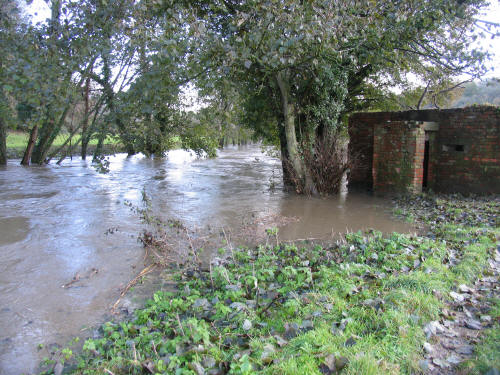
The war time authority made
the mistake of building pillboxes in the flood plain. Here's a photograph
of one taken recently!
This flood didn't extend far into the fields but did threaten The Inn
at Freshford where staff had sandbags ready. Unfortunately for this
website, water that was in the fields had retreated by morning preventing
recording the full extent of the flood. This photograph doesn't convey
how strong the current was. However, photos taken down river at the
bridge at Freshford show the full force of the river.
The Flood risk information page including maps and photos would
convince any reasonable person that what amounts to building a new settlement
should NOT be undertaken at Freshford Mill. The Association of British
Insurers have also stated that the risk of flooding is getting worse.
In this country the only land
that is left, is land that previous generations would not build on for
what to them were obviously sensible reasons. What we have now
is pressure to NOT build on unsuitable land. (deduced from the ODPM's
website) but local authorities pressured by central government to build
more and more housing! This housing is meant to accommodate not
only indigenous citizens of the British Isles which is increasing quite
slowly but the increasing number of people from the European Union (EU)
which is expanding, the Old and New Commonwealth and a migration of
UK citizens to Southern England, whilst more and more British citizens
are emigrating mainly to Australia and New Zealand.
All citizens of the EU that
of course includes the UK and the Irish Republic are entitled to live
and work and draw benefits in every other EU country. One major
benefit of living in England is, apart from better work opportunities,
the extremely important acquisition of the ability to speak and read
the English language, a skill that has global value. The net inflow
of emigration, whether for a limited period or not, is that the population
of the UK and Eire is increasing whilst the attraction for indigenous
citizens to go abroad - to Poland or Italy for example to live and work
is almost non-existent. This factor and refugees, who favour
this country rather than France, for example, is adding to the escalation
in house values. Unfortunately, land like fossil fuel is a finite
quantity and with global warming our gross land area will reduce in
size. Already, it is realized that the coastal defences need to be partially
disabled rather than improved to allow the seas to reclaim the land.
If in future, the near future according to some forecasts, we need to
grow more food within these islands we will need every acre or hectare
of land that we have. In this case, the river Frome valley in
Freshford is only suitable for sheep and cattle; and possibly for rice.
Roads in the countryside are
fewer than in town, although there aren't so many cars in the countryside
the roads can be busier than in town, there is often no choice in going
from A to B, as in the countryside residential roads are scarce.
Photos of road junctions
Staples Hill. the unclassified
road that is the main road leading into Freshford from the east is actually
busier than where I used to live in London! (Crouch End)
Only lanes lead to Freshford
Mill. single track roads with no passing places. BANES Development Committee
decided to approve the application after consulting various reports.
The Transport Assessment (TA) that Surrey & Counties (Suttons) Ltd commissioned
from David Tucker Associates (DTA) is available to read on the
BANES Planning Services Public Access web site. In that assessment DTA
made a number of conclusions that need to be scrutinised.
DTA's Traffic Assessment
concludes that 'the proposed residential scheme fully accords
with Government policy to reduce the need for travel and to create sustainable
communities. The transport assessment demonstrates that the proposed
use will generate significantly less traffic than the historic or permitted
uses and that the adjacent highway network can safely accommodate the
forecast traffic flows.'
1. This is perhaps, the only
proposed settlement where for emergency access boats will be needed!
1.1 Reduce
the need for travel? what by building a settlement where unless the
residents use their cars they will have to walk along narrow, twisting
dark lanes that are subject to flooding to a railway station over 1km
away. Estimated time by foot over 40 minutes a day? excluding getting
from the destination station to the workplace!
1.2 DTA's
Traffic Assessment has an old survey of where existing residents
work. One excellent way of reducing the need to travel, as there is
no work in Freshford is to move to Bath or Bristol or Trowbridge or
. . .
2. Freshford is not even sustainable,
consider the list below, so how can Freshford Mill be sustainable?
2.1 it has no shop, except
the post office that is now closed.
(nearest post
offices) (The new Galleries shop due to open
end of July 2009 will have a post office service. Ed)
2.4
a primary school that is almost full, that has recently been extended,
with no room to extend further
2.5 an
infrequent bus service that only runs for part of the day
2.6 a limited
train service, where you have to hail the driver, that had a massive
gap from platform to carriage until recently (offering a worse service
than a cattle truck)
2.7 traffic
chaos by the school in the morning, and afternoon, as there is no parking
spaces for parents
2.8 sustainable
communities have local jobs Freshford has: The Inn, the school, and
the post office, which is closing
NB I forgot to mention
that I cycle to the nearest bank in Bradford On Avon a return distance
of 6 miles form the centre of the village Although there is a
post office-shop at Westwood.
3. 'generate significantly
less traffic than the historic or permitted uses'
3.1 YES
I AGREE IT WILL as when the Freshford Mill site was used by Peradins
the amount of traffic was
unbelievable: '. . . that between 6am and 9am on an average day in 1969,
eighty-two cars and two coaches arrived at the works' and ' enormous
articulated lorries were bringing raw materials from the Midlands, and
transporting manufactured goods to car plants and ports. the size of
these lorries was increasingly incompatible with the ancient pattern
and size of roads, lanes, hills and bridges, and incidents frequently
occurred.'
This
material is from respected local historian Alan Dodge's book Freshford:
the History of a Somerset Village, p244-245 (comment: a fascinating
and most scholarly contribution to the History of our countryside)
3.2 'or permitted use' the site can be used as a factory and
if it were to be, even though there has been virtually no interest in
the site since Peradins finally left in 1995, 'the amount of traffic
would be considerably more than its proposed residential use'. This
does not mean that there will NOT be an unacceptable increase in local
traffic, which has been steadily getting worse, and worse, if
two dozen dwellings are built.
4. 'the adjacent highway
network can safely accommodate the forecast traffic flows'
4.1 we all know
about what the highway authorities think of road safety: until someone
is killed they don't recommend pedestrian crossings etc.
4.2 as to reducing stress, noise, safety for pedestrians, cyclists and
equestrians . . .what about the government's plan to have "Quiet
roads"? http://www.cpre.org.uk/news/view/11
surely this part of the countryside should qualify?
4.3 'a
single track road with passing places can carry a two way flow of up
to 300 vehicles an hour' i.e.. one vehicle every 12 seconds, 'the new
settlement will not generate these levels' but this statistic is
less than the existing level inStaples Hill during peak times
now! what passing places? (I do not have time to open my rear car
door!)
I certainly
would not walk along Staples Hill during the day, it's too dangerous,
I am lucky I can use a bridleway and footpaths. No such luck for the
would be residents of Freshford Mill. If this development goes ahead
there will be more pressure for residents to use their cars for
local use,as the safest place to be on the road is inside
a vehicle. There is no evidence on the Internet for the last
statement, but if you think about it, (do you need to?) it is self evident!
Motorways are safer than other roads.
http://driving.timesonline.co.uk/article/0,,15149-1565657,00.html
Even the customers of the local pub, The Inn, use cars to get there!
I do not suppose
that anyone contemplating buying a property in Freshford or other parts
of the countryside has any illusions about whether their proposed purchase
will be value for the money invested. But first it should be realised
that property located in the countryside that has no garden tends to
change hands more frequently and is harder to sell.
The estate
at Freshford Mill or whatever it will be called will have to levy a
service charge for sewage treatment and maintenance of the community
gardens and infrastructure including security. These charges increase
the cost of living at Freshford Mill and will obviously affect the resale
value of the dwellings. Will the properties be Freehold or Leasehold;
a thousand year lease? Bath will probably be a seaside resort in a few
hundred years time and the river Frome will be tidal.
Corruption of Public Officials?
But before the dwellings are
built someone has to be prepared to take on the uncertainty of borrowing
several million pounds to invest in the development that will surely,
always cost more than anticipated.
There is talk that BANES planning
is corrupt. After all they have not published their rationale for approving
this application. So much for local democracy and open government.
Of course this is merely talk, that arises from the resentment that
residents have, to what appear to them, to be the unacceptable approval
of planning applications when most of us have difficulty getting planning
permission for a shed! Why haven't BANES planning department published
the full text of the meeting that approved the application by Suttons.
This documentation would have helped residents to raise objections that
could be put before the councillors who eventually approved the application
by five to three. And might even have changed the councillors minds
about the proposal. Why isn't there a citizens right to inspect the
written and other records that should be made whenever there is a meeting.
Without these records, these meetings are effectively "secret meetings"
If
the proposed development goes ahead, there will be 21 new dwellings
for sale. These dwellings are new, they did not exist before, never
in 1,000 years of history have dwellings been built on this site. The
main reasons being: risk of flood and living in a damp environment.
In the winter, for example, sunshine when it does shine, disappears
after 12:00 noon in the valley bottom.
So Who May Consider Buying These Dwellings
Married Couples
Who will decide to buy these
dwellings? Surely not married couples who are intending to rear
a family? Consider the following:
1. the local primary school
has very few vacancies and has been extended recently, with little room
for further expansion. A number of children are being educated privately,
this has created some vacancies. It has also removed some of the brightest
children from the school, at worst, or altered the balance of ability
and behaviour at best.
2. the trip to school is dangerous,
and time consuming on foot, you will need to use your car.
3. The dwellings don't have
their own gardens, and the communal gardens will most likely be ruined
by flood waters regularly.
4. the river Frome although
beautiful is dangerous, very dangerous, your children will be
living close to it.
Second Home Buyers
So who will buy these
dwellings? wealthy people looking for a second home? This is
an isolated settlement, it could easily be the target of thieves. or
worse, vandalism (which is alive and kicking in the west country, there
is an anti-cultural element!) police don't "exist". (response time London,
999, crime in operation: 90 seconds) this is not to blame the
local police force, this is a large area!!
Single Professional Buyers
So who will buy these dwellings?
young single professional people who work in Bath or Bristol? This is
an isolated settlement, it could easily be the target of thieves. You
will either have to spend an increasing amount of money on fuel or use
the train - inconvenient and time consuming and the service could be
withdrawn and the fares will go up! Bristol takes at least 2 hours a
day, there and back, to get to by car. What does that travelling time
mean, well even if you pay yourself at an unskilled rate of say £10
an hour and only travel to work for 300 days a year it will cost you
£6,000 of course if you value your time more highly then you should
increase the amount and don't forget to add the cost of fuel.
I would have thought that young professional people tend to prefer to
live more centrally, in former docks areas of a city centre for example.
Retired
people?
1. You will be dependent on
your car and your telephone as this is an isolated settlement, it could
easily be the target of thieves.
2.This is a damp, frosty area,
being in a valley, it is not a healthy place to live.
3. the Frome valley gets darker
earlier than the adjoining hillsides ,this is especially noticeable
in the autumn and winter months. Don't you want to sit in the sunshine
in the evening? and then there are the midges!
4. when there is a flood, which
is certain, you will lose your car unless you decide to evacuate your
home until the flood subsides. Or having planning approved the building
of a platform, which is sure to be unsightly, to park cars on when there
is a flood?
Message
to all potential residents: people have not lived on this site for
the last 1,000 years. Correction, never! except for those individuals
who have been virtually forced to live here.
I have been driven with the
desire to protect this exceptionally beautiful part of our countryside.
84% of the population of the UK live in England, that's 50 million
people, and as mentioned elsewhere on this website apart from the Netherlands
we are the most densely populated country in Europe. We
therefore, need to take a strong stand against development in the countryside.
There are so many objections
to this proposed development that Freshford Parish council have so clearly
presented, that are in no way a reflection of just the views of
local opinion, but have far reaching implications for the UK and for
other areas of the EEC, that the existing decision needs to be confirmed
by central government scrutiny. This is the classic Slippery Slope
situation where approval may lead to other applications to build on
green belt land and within areas of outstanding natural beauty and areas
of special scientific interest. Or at least, provide the grounds to
cover footpaths and bridleways with tarmac and destroy ancient lanes
and byways.
The fact that it is necessary
to have to create a website to support our objections is worrying,
it is absolutely incrediblethat this planning application
could be approved. We have had to fight the continual application
of Suttons' to make a profit from their purchase of the Freshford Mill
site. I have no sympathy for the company, but maybe planning do, as
this settlement will remove the eyesore, with no public expense.
I can find no other reason for approving
this planning application other than that. There is another explanation
that is that there is corruption. On reflection there may be another,
that is that the approval of this real estate for property development
will deter the building of a major road through the Frome and Avon valleys.
Who
knows what may be approved in future. The vicious scar that has been
slashed in to the gentle hillside to accommodate alterations to the
A46 trunk road at Bath further down the Avon valley is the sort of "development"
that could happen virtually anywhere in this little island of ours.
The new road is subject to a 50mph speed limit and needs speed cameras
to control motorists who have a nice wide open straight road to speed
down. The old road kept motorists from speeding anyway.
Maybe
approving this particular development is the price we have to pay to
forestall development in the future. Maybe this is what the planners
were thinking about. (probably if the government decided to reroute
the A36 into and across the Frome valley they would anyway!)
I am quite happy, in
fact I would welcome, the opportunity to include the argument for approving
this application if requested, from both the planners and those that
were minded to permit. View:
Reasons for approval.
I have provided in
this website support for objections already raised by Freshford Parish
Council. In Freshford we are blessed with Parish council officers who
have the skill to formulate our objections to such planning applications.
God help those authorities
who do not have such capable people, as we seem to have lost the
protection of the government. In the mistaken belief that local autonomy
will be more able to make the right decisions.
In this particular case, we
have a majority of two councillors, two abstained. So these two individuals
have approved a far reaching decision to build a new settlement on not
just the green belt but in an area of outstanding natural beauty and
an area of high ecological value (with protected species)
and in my opinion
an exceptionally beautiful location within these designated areas. I
would be interested to hear from anyone who thinks that there are other
areas that have this beauty within Bath and North East Somerset and
West Wiltshire, Are there nicer areas? Apparently not, no response after
over 2 years. (over 18,000 visitors to the web site Nov 2007)
Did these councillors
make the right decision, do they still think they did? Why are they
silent?
Some, possibly
corrupt, at worst, or ignorant at best, officials approved
the Peridins development in war torn Britain and now we
have to live with that decision. Our national and international
authority (EEC) have absented themselves from this decision.
This means that the site could be legally used for industrial
use. It doesn't say much for the law as an instrument to
protect the environment does it? They agreed to industrial
use. Change of use to residential is another matter. Suttons's
haven't been able to sell the site to an industrial user.
Easy, just set the price too high, this leaves an alternative,
sell the site for residential development. And claim this
is the only alternative. I was told by a representative
of the company that a possible acceptable redevelopment
of the factory site would be to build four houses, but was
told that this would be financially impossible due to the
costs of the extensive cleanup of the ground and removal
of the buildings and all the other infrastructure requirements.
Much has been said
about sustainability yet here we have an ideal location
for a working mill to generate electricity for the local
community with a surplus that could be sold to the National
Grid. Or will we have to face the imposition of windmills
on our hillsides in future?
My personal view, which is in sympathy
with an already approved planning application presented
by the village is that public money should be spent on clearing
up the site as the damage was caused by publicly elected
authorities in the past. That a proper working mill be incorporated
in to the old mill buildings. And that the area should be
used for recreation and conservation by locals and visitors.
The case for a working mill on the River
Frome (Somerset) to generate electricity may be reviewed
here:
Natural Power?
What we need is a public
enquiry into approving Freshford Mill for dwellings
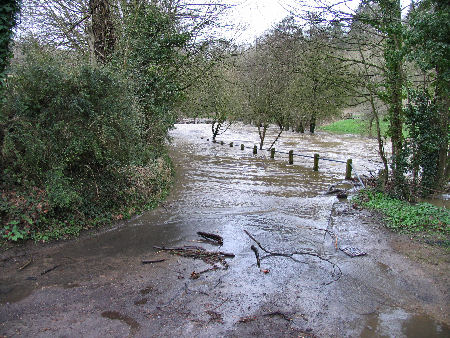
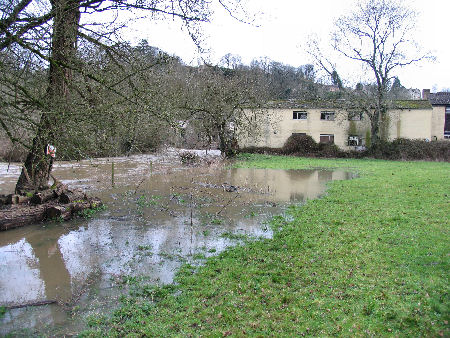
 This flood didn't extend far into the fields but did threaten The Inn
at Freshford where staff had sandbags ready. Unfortunately for this
website, water that was in the fields had retreated by morning preventing
recording the full extent of the flood. This photograph doesn't convey
how strong the current was. However, photos taken down river at the
bridge at Freshford show the full force of the river.
This flood didn't extend far into the fields but did threaten The Inn
at Freshford where staff had sandbags ready. Unfortunately for this
website, water that was in the fields had retreated by morning preventing
recording the full extent of the flood. This photograph doesn't convey
how strong the current was. However, photos taken down river at the
bridge at Freshford show the full force of the river.